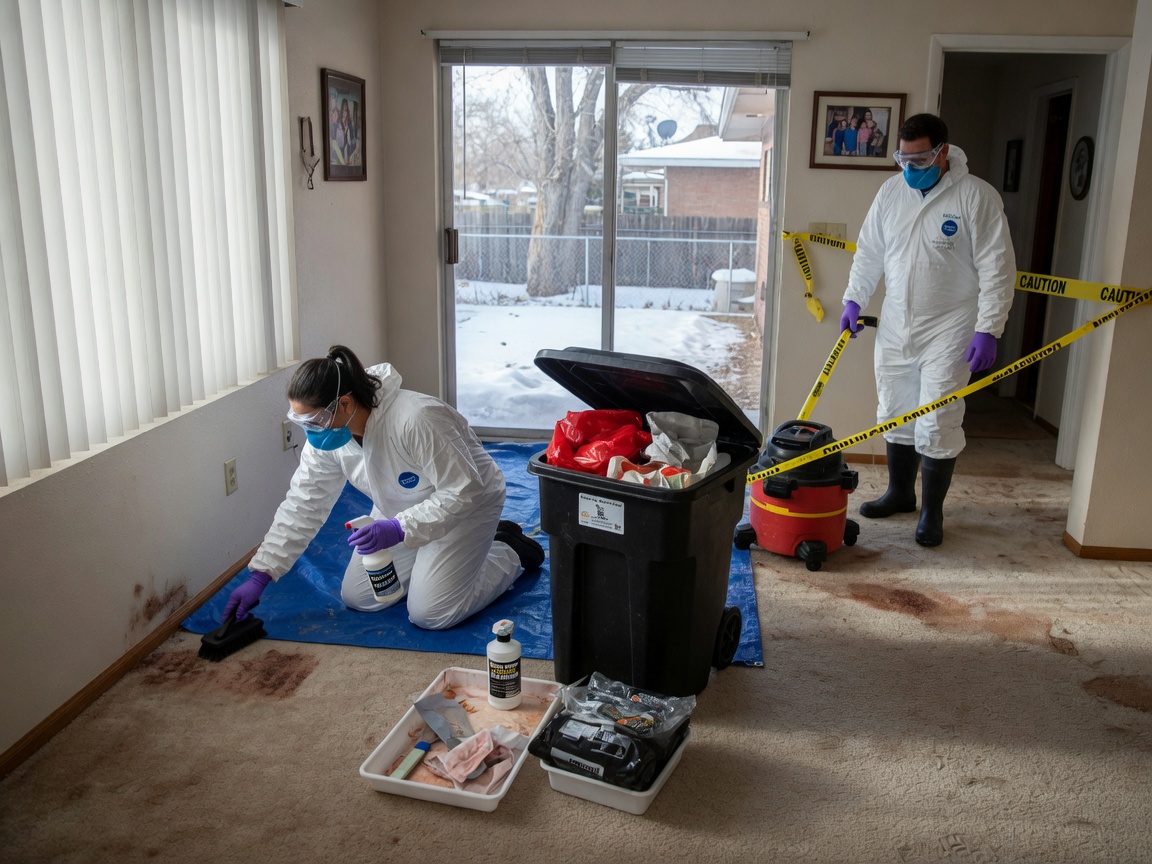
Historic Littleton features narrow streets and older single-family homes built mostly before 1950 around the Littleton Town Hall and Bemis Public Library. Crews respond to calls in these tight lots where alley access is limited and basements are common, requiring careful containment to avoid spreading biohazards through shared walls or crawlspaces. The semi-arid climate with low humidity and four distinct seasons means winter jobs often involve frozen surfaces that thaw during transport, while summer heat accelerates drying of residues on stucco and wood siding.
We cover the core Historic Littleton district bounded by Main Street, Nevada Street, and the South Platte River corridor. Properties here sit on smaller parcels with mature landscaping that can block equipment staging, so teams stage at nearby curb access points and carry gear by hand when needed. Proximity to Englewood and Denver means traffic on Santa Fe Drive can add response time, which is why 24 Hour Dispatch keeps a local crew staged for immediate rollout.
Around Historic Littleton
We regularly work near:
- 📍Littleton Town Hall
- 📍Bemis Public Library
- 📍Littleton Museum
- 📍Sterne Park
Crime Scene Cleanup in Historic Littleton — Local Notes
- •Pre-1950 homes around Littleton Town Hall often have narrow interior hallways and steep basement stairs that limit gurney movement during removal.
- •Low humidity in the Arapahoe County portion of Historic Littleton speeds surface drying but leaves protein stains embedded in unsealed hardwood floors common in the district.
- •Winter temperature swings near Sterne Park can freeze fluids on exterior concrete, requiring heated extraction tools before standard cleaning protocols begin.
- •Tight rear alleys behind Bowles and Wolhurst edges of the historic grid restrict truck positioning, so crews frequently use smaller containment kits carried from Main Street parking.